applied-ai-automation
Applied AI and automation
Copilots, agents, RAG and automation when data, context, boundaries and operational value exist.
Single-tenant operations platform for assets, maintenance, incidents and document AI.
A VEI product for deploying a dedicated operations platform per client, with API, web app, database, worker, backups, auditability and AI-assisted document knowledge.
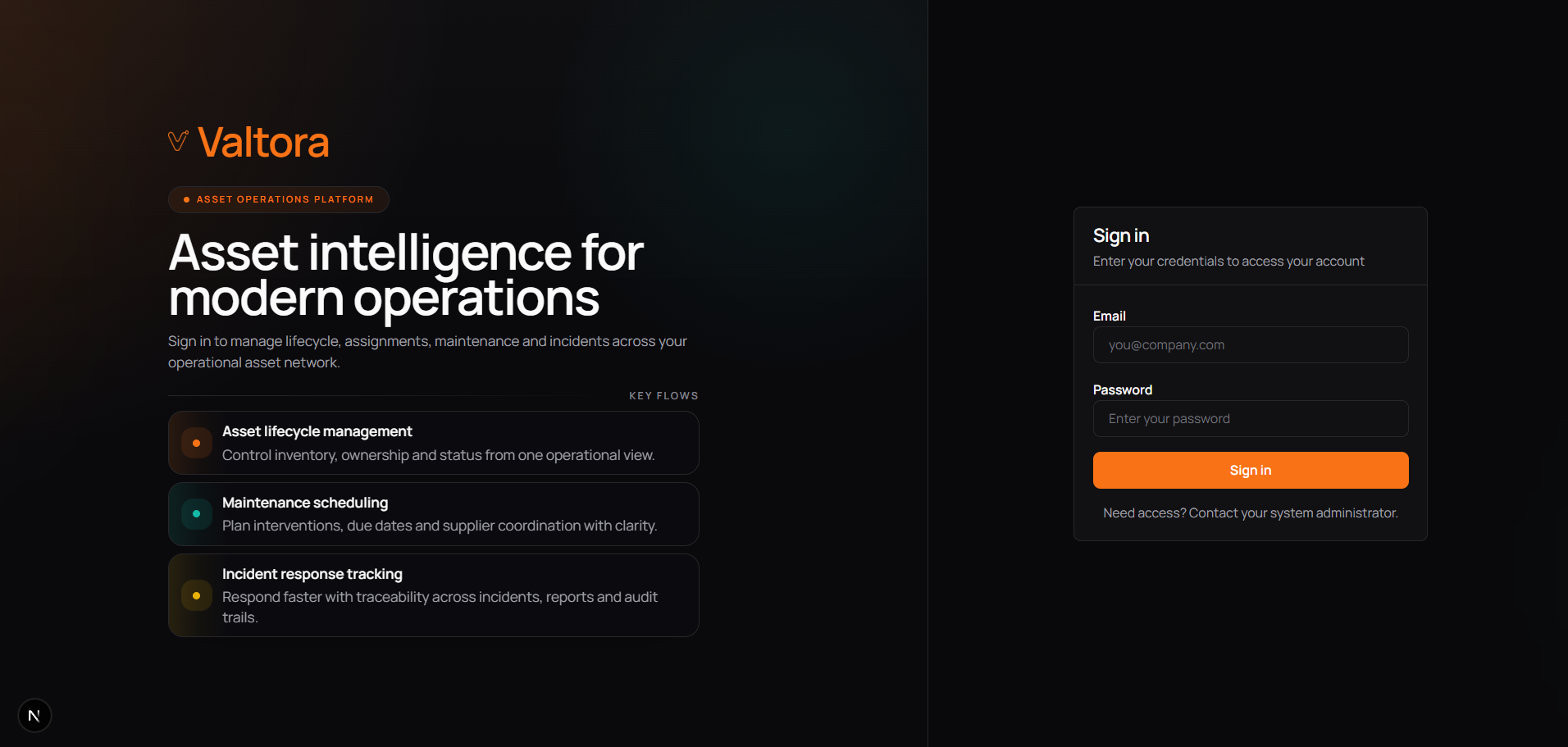
Valtora was solved as a modular operations platform, not as a closed application. The foundation combines assets, locations, assignments, maintenance, work orders, incidents, requests, inventory, suppliers, audit logs, users, roles, imports, exports and configuration. Each module answers a concrete part of the operation, but they all share the same logic: traceable data, clear states and visible responsibilities.
The architecture was prepared for dedicated deployments per client. This makes it possible to separate databases, secrets, configuration, backups and auxiliary processes. The product can be implemented from a common base and adapted by sector without turning each sale into a completely new custom build.
On top of that foundation, AI-assisted document knowledge was added. The goal is not to replace the team's judgment, but to bring manuals, procedures and internal documentation closer to the moment of decision. AI makes sense because it works over the client's own information and because answers can be backed by visible evidence.
The challenge behind Valtora was to turn a common operational need into a sellable product. Many companies manage assets, maintenance, incidents and internal documentation through a mix of spreadsheets, emails, folders and informal knowledge. That system can work for a while, but it becomes fragile when teams grow, responsibilities change or an incident requires the full history to be reconstructed.
The difficulty was not just building screens. The challenge was defining a product foundation that could be implemented for different clients without starting from zero each time. It had to be modular enough to adapt to different sectors, but consistent enough to remain a product. It also had to solve an important tension: offering customization without losing technical control.
The single-tenant approach also forced the whole operating model to be considered. A good-looking application was not enough. The architecture needed to support dedicated installations, separated data, per-environment configuration, backups, support and evolution per client. The platform had to be commercially presentable as a serious solution, not as an internal experiment.
Technical base
Dedicated installation per client with an isolated service layer, administration interface, database, auxiliary processes and backups.
Modules for assets, maintenance, incidents, work orders, inventory and suppliers.
Document RAG with evidence for manuals, SOPs and internal documentation.
Audit logs, roles, permissions, import/export and reporting prepared for daily operations.
Project gallery
Valtora starts from one conviction: asset-heavy operations do not need another isolated tool, they need a working layer that connects information, responsibilities and decisions. The product is designed for companies with physical or digital assets, teams that work on them, scattered technical documentation and the need to understand what happened at each point in time.
The platform was not approached as another admin panel. It was approached as an implementation base. That changes the focus: each screen must answer a real process, each field must have operational meaning and each module must be able to grow without breaking the overall experience.
The core of the product is the operating model. First, the system defines what an asset is, where it is, who manages it and what information should travel with it. Then requests, incidents, maintenance and work orders are connected. From there, the pieces that mature the system appear: audit logs, roles, permissions, reports, imports, exports and per-client configuration.
The important decision was to avoid turning Valtora into a pile of forms. A platform like this has to help users understand what needs attention, what is blocked, what has already been solved and what information belongs to each case. The interface should help people decide, not only record.
The single-tenant model shaped the architecture from the start. Each client can operate in a dedicated environment, with isolated data and its own configuration. This is especially relevant in projects with sensitive information, internal processes, maintenance histories or technical documentation that should not be mixed with other clients.
Dedicated deployment also makes support clearer. If a client needs to restore a backup, adjust configuration, activate a module or review logs, the analysis happens within that client's own installation. That separation reduces operational complexity and improves commercial trust.
Valtora covers asset management, locations, owners, categories, relationships between elements, maintenance, incidents, requests, work orders, inventory, suppliers, audit logs, users, roles and configuration. These modules are not designed as independent pieces, but as parts of the same operational story.
For example, an incident can be connected to an asset, an owner, a location, technical documents, a work order and an intervention history. That relationship is what makes the system more valuable than a ticket register.
An important part of the product is the relationship between operations and documentation. Many companies have manuals, warranties, procedures and internal documents, but they do not use them effectively because they are far from the workflow. Valtora brings that knowledge closer to the context where it is needed.
Document AI is included with a practical criterion. It should help people find answers, but it should also show where those answers come from. In maintenance, support or diagnostics, trust matters. A fast answer without evidence can be worse than a slow search. That is why the AI layer is designed as a consultation assistant, not as a decision replacement.
Client value appears at several levels. In the short term, the client gains order: a clear way to register assets, incidents, owners and tasks. In the medium term, the client gains traceability: the ability to understand what happened, detect repeated problems and improve processes. In the long term, the client gains a base from which to automate, measure and make decisions with more context.
Valtora also reduces dependence on specific people. When knowledge only lives in the person who has been solving incidents for years, the company operates with invisible risk. By turning processes and documents into a shared platform, that knowledge starts becoming part of the system.
For VEI, Valtora is more than a technical project. It is a product line. It packages experience in architecture, web applications, automation, data and AI into a repeatable offer. Each implementation can improve the common base and open new commercial verticals.
The model also creates a recurring relationship with the client. It is not only about delivering an application, but about operating and evolving an installation. That opens room for monthly maintenance, new modules, integrations, data loading, automations and improvements to document intelligence.
Valtora is now a platform prepared to be presented, implemented and evolved. Its strength is not promising that one tool can solve an entire company, but precisely targeting a recognizable operational problem: too much critical information spread across too many places.
The product turns that fragmentation into a maintainable structure. It gives assets a place, incidents a flow, interventions a history and documentation a useful role. That combination is what makes it meaningful as an owned product and as a VEI case study.
applied-ai-automation
Copilots, agents, RAG and automation when data, context, boundaries and operational value exist.
cloud-infrastructure-devops
Deployments, environments, CI/CD, containers, infrastructure, backups, scaling and technical operations.
critical-platforms
Digital products, backoffice, internal systems and custom integrations when operations depend on software.
operational-platforms-workflows
Systems to coordinate states, tasks, owners, approvals, incidents and recurring work.
rag-document-intelligence
Semantic search, knowledge bases, sourced answers, extraction and exploitation of documentation.
technical-architecture-strategy
Diagnosis, architecture, roadmap and technical decisions to invest, build and evolve with less risk.
technical-governance-evolution
Modernization, observability, security, maintenance and continuous improvement of critical systems.
Tell us the context and we will design a clear route to build it.
Request information