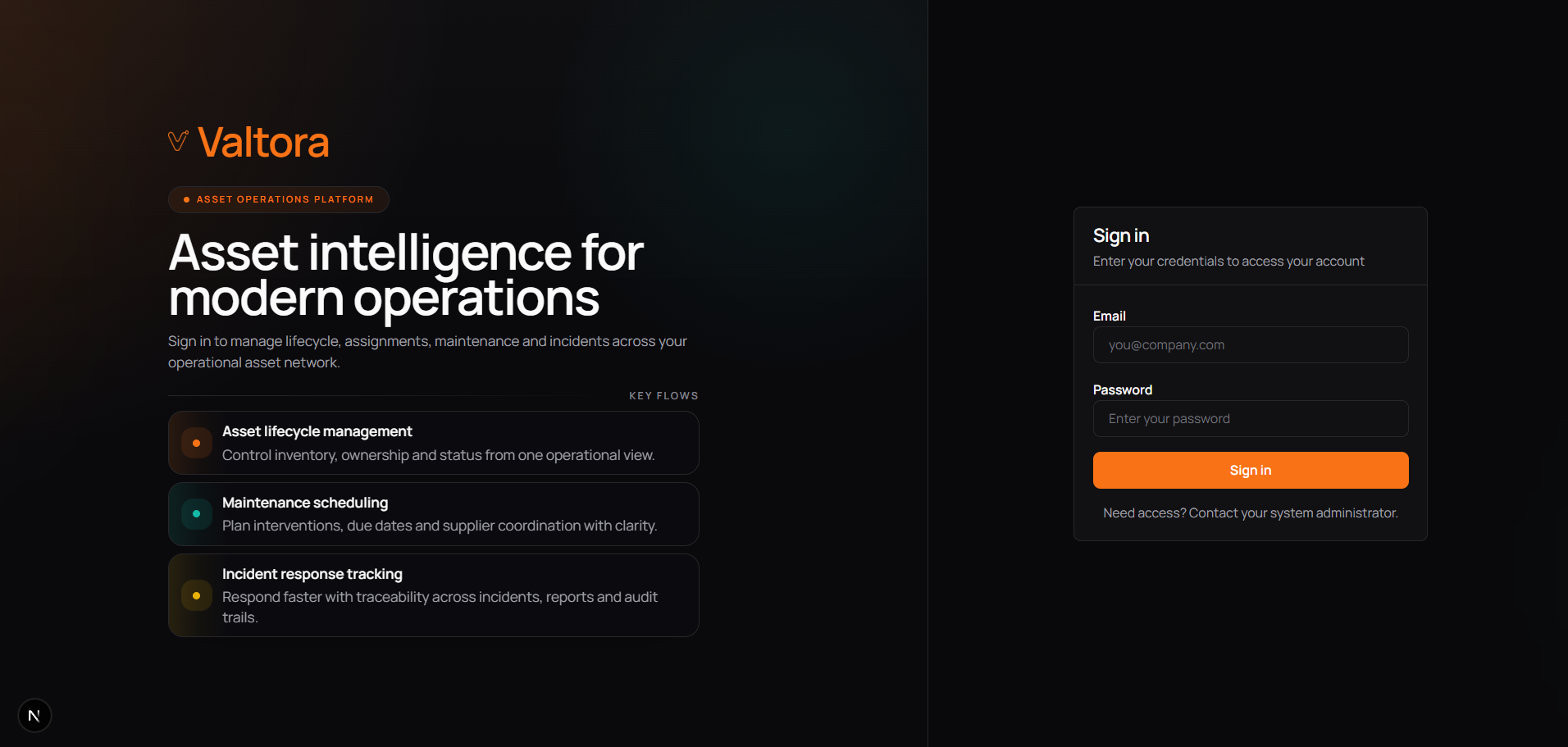
Valtora is a modular operations platform for organizations that need to govern assets, maintenance, incidents, requests, inventory and internal knowledge from one environment. It was built as a VEI product around a simple idea: when an operation depends on too many spreadsheets, conversations, folders and specific people, the problem is not only tooling. It is continuity, traceability and trust.
The product is designed to be sold as a single-tenant deployment. Each client can have its own installation, database, secrets, backups and operating lifecycle. That is not only a technical decision. It is a way to sell software to companies that need control over their data and do not want a critical operation to depend on a shared architecture with little room for adaptation.
Why the product exists
Most operations do not break suddenly. They wear down slowly. First there is one spreadsheet to register assets. Then another one for incidents. Then a folder with manuals, an email with instructions, a conversation where someone approves an exception and a document that explains a procedure nobody finds when it is needed.
That disorder does not always show in the first month. It works while the team is small, while key people are available and while the volume of work is still manageable. The real problem appears when requests grow, maintenance tasks accumulate, responsibilities change or an incident requires the team to reconstruct what happened, who intervened, which asset was involved and what decision was made.
Valtora exists to cover that space. It is not a generic productivity tool. It is also not an artificial intelligence wrapper trying to look operational. Its focus is on operations that need a serious foundation: well-modeled assets, clear states, history, permissions, auditability, useful documents and an experience that lets people work without turning every task into manual search.
The problem it solves
The main problem is fragmentation. When a team does not have a common operating system, every area creates its own method. Maintenance records one version of the truth, administration keeps another, support tracks another and leadership receives a summary that often arrives too late. The information exists, but it is not connected.
That disconnection has very concrete effects. Incidents are solved without accumulated learning. Assets have a physical life but no digital history. Requests get lost in informal channels. Priorities are decided by visible urgency rather than real impact. Internal documentation becomes passive storage that almost nobody consults because searching takes longer than asking another person.
Valtora approaches that problem from one premise: an operations platform should make daily work clearer, not only store information. That is why the product structure revolves around real processes: register, assign, maintain, solve, document, audit and learn.
Why single-tenant matters
Single-tenant matters because many organizations want adaptable software, but they also want to know exactly where their data lives. In a traditional multi-tenant product, clients share the same logical infrastructure base. That can be efficient, but it does not always fit operations with specific security, compliance, restore or customization requirements.
With Valtora, each client can run in a dedicated environment. This makes it easier to separate data, configure modules by context, manage backups per installation and evolve each project without forcing all clients to move at the same rhythm. For VEI, it also simplifies support: an incident, restore process or adaptation can be understood within the client's own environment instead of being mixed with variables from other deployments.
The result is closer to a product implementation than a generic subscription. There is a common base, but each installation can respond to the client's operational reality.
The functional architecture
Valtora is organized around several cores. The first is asset management: what exists, where it is, who owns it, what state it is in and how it relates to other elements. Without that layer, any maintenance or incident record is floating without enough context.
The second core is the operating flow. This is where requests, incidents, work orders, states, priorities and owners live. The goal is not to create bureaucracy, but to make it stable and clear what is open, what is blocked, what needs a decision and what has already been solved.
The third core is traceability. A mature operation needs to look back. Not to assign blame, but to understand patterns: which assets fail more often, which tasks repeat, where delays accumulate, which provider appears frequently or which procedure needs to be reviewed.
The fourth core is internal knowledge. Manuals, warranties, SOPs, instructions, policies and technical documentation often live outside the workflow. Valtora brings that information closer to the point where decisions are made.
Where artificial intelligence fits
AI in Valtora is not the main character. It is a support layer. Its usefulness appears when it helps people find information, summarize evidence or connect a question with internal documentation that already exists.
A simple example: a technician opens an incident, checks documents related to the asset and receives an answer based on verifiable fragments. The difference is not that AI "answers". The difference is that it shortens the path between the problem and reliable information, without forcing the team to navigate folders, file names or outdated versions.
This orientation matters. In real operations, an answer without evidence can be risky. The right approach is not to replace human judgment, but to help the team find context, manuals and previous decisions before acting.
Why it can be sold
Valtora is sellable because it combines product and service. It is not a closed application the client has to understand alone, and it is not a custom build that starts from zero every time. The proposal sits in the middle: a product base with reusable modules, guided implementation, industry configuration and monthly maintenance.
This makes the offer clear. First, the client's operation is analyzed. Then the required modules, initial data, roles and workflows are defined. From there, a dedicated installation is deployed and the evolution is supported over time.
For the client, that reduces risk. For VEI, it creates a business line with more continuity than a one-off delivery. Every installation can improve the product base, generate learning and open new templates by sector.
What makes Valtora different
The difference is not a single screen. It is product judgment. Valtora assumes that an operations platform should be solid before it is impressive. It should be clear before it is decorative. It should prioritize states, permissions, histories, consistent data and continuity.
It also assumes that AI only creates value when it is integrated into a process. If it is added as a marketing layer, it distracts. If it is used to bring knowledge closer to the moment of decision, it improves the operation.
Valtora makes sense for companies that need to organize operations involving assets, maintenance, incidents or technical documentation, but do not want to depend on a rigid solution. It makes sense when the client needs control, adaptation and a serious implementation. And it makes sense as an owned product because it turns VEI's technical experience into a repeatable, maintainable and scalable offer.
The underlying idea
The thesis behind Valtora is that many companies do not need more isolated tools. They need an operational layer that connects work, assets, knowledge and responsibility. When that layer exists, the organization stops running on informal memory and starts running on a system.
That is the real value of the product: not promising abstract transformation, but making daily operations more visible, more traceable and easier to sustain over time.